Winter is hard on warehouses and manufacturing facilities. Five months of cold weather, tracked-in salt, reduced ventilation from sealed doors and windows, condensation, moisture-driven corrosion, and the accumulated grime of running production through the darkest, wettest months of the year leave behind a facility that is dirtier, dustier, and more worn down than it was in October.
Your crews kept the operation running. Daily sweeping happened. Spills got mopped. The basics were covered. But the overhead steel is coated in a season’s worth of dust. The floor has salt residue embedded in every expansion joint. The dock areas have months of hydraulic fluid, road grime, and de-icer buildup baked into the concrete. The racking is grimy. The break room smells tired. The restrooms need more than a daily wipe-down. And every exhaust fan, vent, and overhead light fixture is carrying a winter’s worth of particulate that is quietly degrading your air quality and slowly settling back onto everything below.
Spring is the reset. It is the one window in the annual calendar when the weather cooperates, production schedules often soften slightly, and a comprehensive deep clean can undo the cumulative damage of winter and set your facility up for its most productive months. This guide covers every zone, every task, and the strategic thinking behind getting it done right.
Why Spring Is the Optimal Window for Industrial Deep Cleaning
There is a reason spring cleaning is a tradition, and it applies to warehouses and manufacturing plants just as much as it applies to your house. The timing is not arbitrary. It is driven by practical factors that make spring the best season to schedule a facility-wide deep clean.
- Doors and dock bays can be opened. Ventilation is critical during deep cleaning, especially when using industrial cleaning equipment, degreasers, or pressure washers. Spring temperatures allow you to open dock doors and bay doors for airflow without freezing the building or the people inside it.
- Winter damage needs to be addressed before it compounds. Salt residue left on concrete floors eats into sealant and accelerates surface degradation. Moisture trapped in cracks during freeze-thaw cycles has expanded those cracks. Dust accumulated on HVAC components during months of sealed-up operation is reducing system efficiency. Every one of these issues gets worse with time. Spring is the intervention point.
- Production schedules often provide a window. Many warehouses and manufacturing operations experience a brief slowdown between winter and the ramp-up to summer production. That dip, even if it is only a week or a long weekend, is the opening a deep cleaning team needs to get into areas that are inaccessible during full production.
- OSHA compliance and audit season. Spring is a common time for facility inspections, safety audits, and compliance reviews. A deep-cleaned facility with documented maintenance is in a significantly stronger position during an inspection than one carrying five months of accumulated grime. Clean floors, clear aisles, functional safety markings, and dust-free ventilation are not just good housekeeping. They are compliance requirements.
- Employee morale and retention. Workers notice when management invests in the condition of the facility. A warehouse that transitions from winter’s grime to a clean, organized, well-maintained environment signals that leadership cares about the workplace. In a tight labor market, that signal matters.
The Zone-by-Zone Spring Deep Cleaning Checklist
Warehouses and manufacturing spaces are complex environments with dramatically different cleaning needs from one area to the next. A loading dock has nothing in common with a break room, and a production floor requires different methods than an office area. The most effective approach is to break the facility into zones and address each one with the appropriate equipment, products, and techniques.
Zone 1: Warehouse Floors
This is the largest surface area in most facilities and the one that takes the most punishment. After a full winter of forklift traffic, foot traffic, tracked-in salt, hydraulic fluid drips, product spills, and general industrial wear, warehouse floors need more than a sweep and mop.
- Sweep and scrape: Start with a thorough dry sweep of the entire floor using an industrial ride-on or walk-behind sweeper. Remove all loose debris, grit, salt granules, pallet fragments, banding material, and accumulated dirt from corners, under racking, along walls, and in expansion joints.
- Scrub: Follow with an industrial auto scrubber using an appropriate floor cleaner for your surface type. For sealed or polished concrete, use a neutral-pH cleaner that will not degrade the sealant. For untreated concrete, a heavier degreaser may be necessary in areas with oil or hydraulic fluid staining.
- Salt neutralization: If your facility is in a region where de-icing salt is tracked in during winter, apply a floor neutralizer to all areas near entrances, dock doors, and high-traffic corridors. Standard cleaners will not remove alkaline salt residue. This step prevents the white haze and long-term surface damage that salt causes.
- Expansion joints and floor drains: Clean out expansion joints where debris, grit, and moisture have accumulated. Flush floor drains with a germicidal cleaner to eliminate odor-causing bacteria and ensure proper drainage.
- Repair and seal: Document any new cracks, spalling, or surface damage for repair. Spring is the ideal time to reseal floors, apply anti-dust coatings, or address trip hazards before the high-production months.
Zone 2: Loading Docks and Receiving Areas
Loading docks are the gateway between the outside world and your facility, and they absorb more environmental punishment than any other zone. Road grime, diesel soot, de-icing chemicals, hydraulic fluid from dock levelers, rain and snowmelt, and constant forklift traffic create a uniquely challenging cleaning environment.
- Pressure wash dock floors, bumpers, pit areas, and aprons to remove embedded grime, oil, and chemical residue.
- Degrease dock leveler pits, which accumulate hydraulic fluid, dirt, and water throughout winter.
- Clean dock door tracks, seals, and weatherstripping. Replace any damaged seals that allowed cold air and moisture intrusion during winter.
- Inspect and clean dock lights, signage, and safety markings. Re-stripe any faded floor markings for forklift traffic lanes and pedestrian paths.
Zone 3: Racking, Shelving, and Storage Areas
Warehouse racking collects dust, particulate, product residue, and cobwebs over the course of a season. It is one of the most commonly overlooked areas during routine cleaning because reaching it requires equipment and time that daily crews rarely have.
- Dust or vacuum all racking uprights, cross beams, and wire decking from top to bottom.
- Wipe down pallet positions and shelving surfaces in pick areas where workers make direct hand contact.
- Clean under and behind bottom-level racking where debris, pallet wrap, banding, and rodent activity tend to accumulate.
- Inspect racking for damage: bent uprights, dislodged beams, missing safety clips, and overloaded positions. Document and report for repair.
Zone 4: Production and Manufacturing Floor
Production areas carry the heaviest concentration of industrial soil: metal shavings, machining coolant, cutting oil, adhesive residue, powder coating overspray, food product residue, or whatever material your operation processes. Spring deep cleaning in these areas often requires coordination with maintenance teams and production scheduling.
- Degrease all production floor surfaces using industrial-grade cleaning agents appropriate for the contaminants present.
- Clean around and under machinery bases where chips, shavings, coolant, and debris accumulate.
- Wipe down machine exteriors, control panels, guards, and safety equipment.
- Clean overhead structures above production areas: beams, pipes, conduit runs, sprinkler lines, and light fixtures that collect airborne particulate from manufacturing processes.
- Inspect and clean dust collection systems, exhaust hoods, and ventilation equipment.
Zone 5: Overhead Structures and High Surfaces
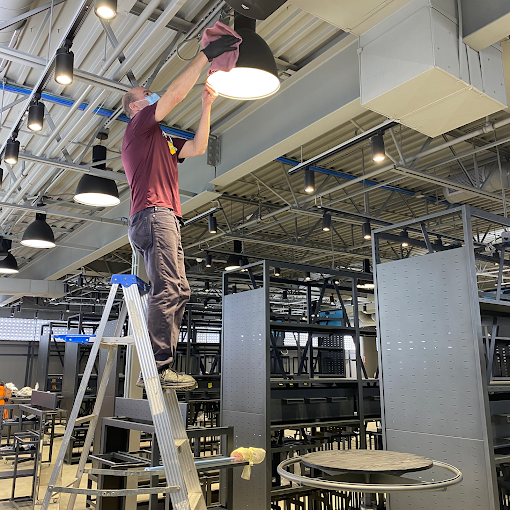
This is the zone that separates a standard cleaning from a real deep clean. Overhead steel, bar joists, sprinkler pipes, light fixtures, hanging signage, cable trays, and ductwork in warehouses and manufacturing plants accumulate significant amounts of dust and particulate over the winter months. That material does not stay up there forever. It falls, carried by air currents, vibration, and gravity, landing on products, equipment, work surfaces, and the people below.
- Use aerial lifts, extension tools, or HEPA-filtered industrial vacuum systems to clean overhead steel, bar joists, and structural members.
- Clean all light fixtures and lens covers, which lose significant lumen output when coated with dust. You may be surprised how much brighter your facility becomes after this single task.
- Dust or vacuum sprinkler heads, fire suppression piping, and cable trays.
- Clean exhaust fans, intake louvers, and rooftop unit penetrations.
Zone 6: Restrooms, Break Rooms, and Common Areas
These spaces may be small relative to the warehouse floor, but they have an outsized impact on employee satisfaction and OSHA compliance. After a winter of heavy use, they need deep attention.
- Deep scrub restroom floors, paying particular attention to grout lines and the perimeter behind fixtures.
- Descale and disinfect all restroom fixtures, including toilets, urinals, sinks, and partitions.
- Deep clean break room appliances: microwaves, refrigerators, coffee machines, and vending areas.
- Clean and sanitize lockers, cubbies, and personal storage areas.
- Wipe down all tables, chairs, and seating. Consider professional upholstery cleaning for any fabric-covered break room furniture.
Zone 7: Office and Administrative Areas
Warehouse and manufacturing office spaces attached to the plant floor accumulate industrial dust that standard office environments never encounter. That fine particulate settles on desks, monitors, filing cabinets, window sills, and HVAC vents, and it requires more than a dusting cloth to remove effectively.
- HEPA vacuum all carpeted areas. Schedule professional carpet extraction if carpet has not been deep cleaned in the past year.
- Wipe down all horizontal surfaces, electronics, and equipment with appropriate microfiber cloths.
- Clean interior windows, glass partitions, and office door glass.
- Clean air vents and return grilles in office areas to prevent industrial dust recirculation.
Zone 8: Exterior and Perimeter
- Pressure wash building exterior around dock areas, entrances, and pedestrian paths.
- Sweep and clean parking areas, especially along curbs where winter sand and salt have accumulated.
- Clean exterior signage, safety markings, and wayfinding.
- Clear any debris from storm drains, retention areas, and perimeter fencing.
- Inspect and clean exterior lighting that may have become obscured by winter grime.
The Equipment That Makes It Possible
Warehouse and manufacturing deep cleaning requires industrial-grade equipment that most in-house custodial teams do not have. This is a primary reason why facilities bring in professional cleaning partners for their spring deep clean.
- Ride-on and walk-behind floor scrubbers: For efficiently cleaning large floor areas with consistent solution application, agitation, and dirty water recovery.
- Industrial sweepers: For removing loose debris, grit, and salt granules from vast floor areas before wet cleaning begins.
- Pressure washers: For dock areas, exterior surfaces, and heavily soiled concrete that requires the mechanical force of pressurized water to remove embedded grime.
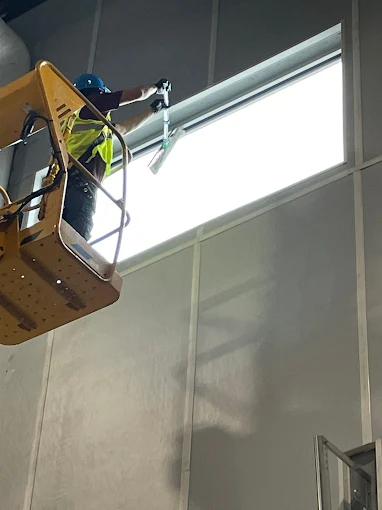
- Aerial lifts and scissor lifts: For safely accessing overhead structures, bar joists, sprinkler systems, and high-mounted light fixtures.
- HEPA-filtered industrial vacuums: For capturing fine particulate during overhead and racking cleaning without releasing it back into the air.
- Floor neutralizers and industrial degreasers: For addressing the specific chemistry of salt residue and petroleum-based contamination that standard cleaners cannot dissolve.
How to Plan Your Spring Deep Clean Without Disrupting Operations
The biggest operational concern with any facility-wide deep clean is downtime. Here is how to plan around it.
- Phase the work. You do not have to clean the entire facility in a single weekend. Break the project into zones and schedule each zone during the shift or window that creates the least disruption. Docks can be cleaned on a Saturday. Overhead work can happen during a second-shift gap. Office areas can be done overnight.
- Coordinate with production scheduling. Identify planned downtime, changeover windows, or low-volume periods and align the most disruptive cleaning tasks with those windows. Even a four-hour gap is enough to scrub a production floor zone.
- Communicate in advance. Notify all shifts about the cleaning schedule, any areas that will be temporarily inaccessible, and what to expect. Workers are far more cooperative when they understand the plan and the purpose.
- Use a professional partner with industrial experience. A commercial cleaning company experienced in warehouse and manufacturing environments knows how to work around active operations, coordinate with forklift traffic, stage equipment without blocking aisles, and deliver results within tight timelines. This is not the same as hiring a general office cleaning crew.
Spring Cleaning Is Not a Nice-to-Have. It Is a Facility Strategy.
A warehouse or manufacturing plant that runs all year without a deep clean is accumulating risk: slip-and-fall hazards from grimy floors, fire risk from dust accumulation on electrical and mechanical systems, air quality degradation from months of recirculated particulate, accelerated wear on flooring and equipment from embedded abrasives, and a slow erosion of the working conditions that affect employee safety, morale, and retention.
Spring deep cleaning is the annual reset that reverses all of that. It is a planned, proactive investment in the safety, compliance, appearance, and operational efficiency of your facility. And the difference between a facility that gets this done every spring and one that does not is visible within five years in the condition of the building, the equipment, and the workforce that operates inside it.