 If you manage a commercial facility, indoor air quality (IAQ) is no longer a “nice-to-have.” It’s a core operational issue tied directly to employee health, productivity, absenteeism, HVAC performance, mold risk, and compliance expectations. And in many workplaces, it’s also the difference between a building that feels clean and one that actually is clean.
Here’s why IAQ matters more than ever—and what facility managers can do right now to reduce risk and improve air quality across their building.
The new reality: “Clean-looking” isn’t the same as “healthy air”
Commercial spaces can appear spotless and still circulate airborne contaminants. Dust, allergens, volatile organic compounds (VOCs), and microbial particles can accumulate in carpets, upholstery, vents, ceiling tiles, and even “hard-to-see” spaces like break rooms and copy areas.
IAQ is impacted by:
Building occupancy and foot traffic
HVAC condition and filtration quality
Humidity control
Cleaning frequency and methods
Water events (even small ones) and hidden moisture
Construction, renovations, or seasonal pollen spikes
When any one of these shifts—IAQ can change fast.
Employee health, comfort, and retention are now tied to IAQ
Poor air quality can contribute to headaches, fatigue, irritated eyes, coughing, allergy flare-ups, asthma symptoms, and general discomfort. Even when symptoms are mild, they create “drag” on performance—people work slower, take more breaks, and are more likely to call out.
Facilities often see IAQ show up as:
Higher sick days (especially recurring “mystery” congestion and coughs)
Increased HR complaints about odors or “stuffy” areas
More frequent requests for desk moves or workspace changes
Reduced morale (“this building makes me feel off”)
A strong IAQ plan supports healthier employees and sends a clear message: we take workplace wellbeing seriously.
Absenteeism is expensive—and IAQ is a controllable factor
Absenteeism affects scheduling, customer service, production timelines, and management time. While not every absence is preventable, IAQ is one lever facility managers can actually influence with practical building habits: filtration, humidity control, routine cleaning, and fast response to moisture.
Think of IAQ like preventive maintenance for people: fewer irritants in the environment means fewer triggers for symptoms and fewer “I can’t shake this” sick days.
HVAC maintenance is an IAQ strategy, not just a mechanical checklist
Your HVAC system is the lungs of your building. When filters are low-grade, changed inconsistently, or the system is dirty, the HVAC can recirculate dust and particles throughout the facility. That can make “problem areas” spread—especially in open office plans, shared hallways, and common rooms.
HVAC and IAQ best practices include:
Using appropriately rated filters (and replacing them on schedule)
Inspecting and cleaning supply/return vents (dust buildup is common)
Monitoring airflow balance (hot/cold spots can indicate poor circulation)
Keeping coils and drip pans clean to reduce microbial growth
Ensuring the building maintains stable humidity (more on that below)
Even the best cleaning program struggles if HVAC is pushing contaminants back into cleaned spaces.
Mold risk increases when moisture and humidity aren’t managed
Mold doesn’t require a flood. It can grow from:
Slow leaks (roof, plumbing, HVAC condensation)
Wet carpet padding that never fully dries
High humidity in restrooms, break rooms, storage areas, or basements
Poor ventilation in enclosed zones
Once mold establishes—even in hidden areas—it can impact air quality and produce persistent odors that are hard to eliminate.
Early warning signs facility teams should never ignore:
“Musty” smells that come and go
Water stains on ceiling tiles or drywall
Warping on baseboards or bubbling paint
Condensation around vents, windows, or pipes
Repeated humidity issues in the same areas
Key principle: Mold prevention is faster and cheaper than mold remediation. Rapid drying, moisture control, and targeted cleaning are critical.
Cleaning methods directly affect IAQ (for better or worse)
Not all cleaning improves air quality. In fact, some methods can make it worse temporarily if they stir up particles without capturing them.
What supports better IAQ:
HEPA-filter vacuuming for carpets and high-traffic areas (captures fine particles rather than redistributing them)
Microfiber systems that trap dust instead of pushing it around
Damp-wiping on surfaces where dust accumulates (rather than dry dusting)
Entry mat systems to reduce outdoor pollutants and fine particulate tracked indoors
Scheduled deep cleaning of upholstery, carpet, and hard-to-reach ledges/vents
What can harm IAQ if done poorly:
Dry sweeping/dusting that aerosolizes particles
Overuse of strongly scented products that add VOCs
Skipping high-touch and high-dust zones (tops of partitions, vents, baseboards, behind equipment)
A professional commercial cleaning plan should align with how your building actually functions—occupancy, traffic patterns, and the areas that generate the most dust and moisture.
Compliance and “duty of care” expectations are rising
Even when a specific regulation doesn’t name “indoor air quality” directly, IAQ intersects with workplace safety, sanitation, and building management standards. In practical terms, organizations are expected to maintain a reasonable, documented approach to cleaning and hygiene—especially in healthcare-adjacent spaces, education, senior services, fitness centers, and high-occupancy offices.
A defensible IAQ-supporting plan typically includes:
A written cleaning scope with frequencies (daily/weekly/monthly)
Documented disinfection methods for appropriate areas (not overdone, not underdone)
Clear HVAC filter schedules and service logs
Moisture-response procedures (what happens within the first 24–48 hours matters)
Vendor accountability (checklists, inspections, and measurable outcomes)
This isn’t about fear—it’s about reducing liability and showing consistent standards.
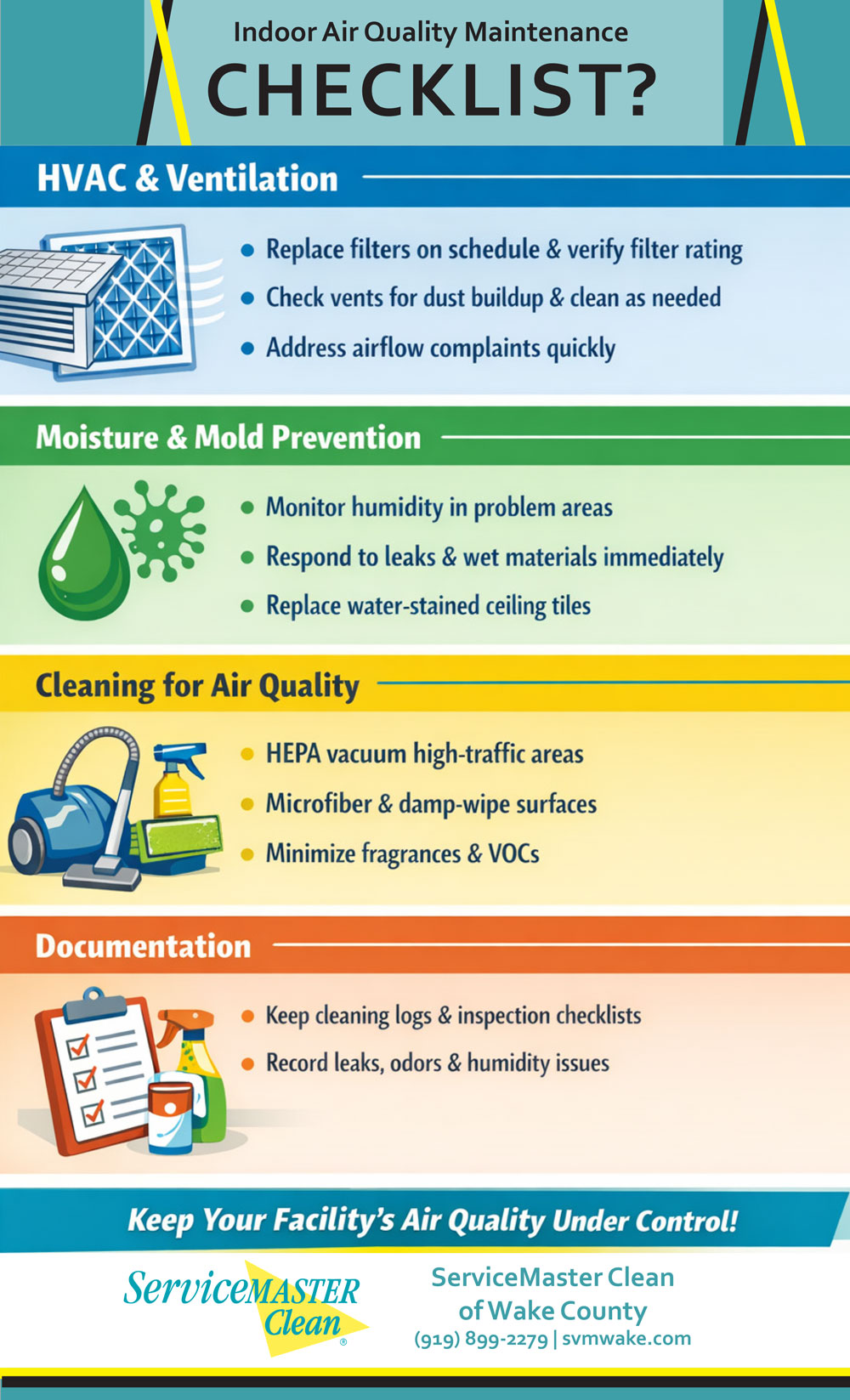
Practical IAQ Improvement Checklist for Facility Managers
Use this as a quick action list you can implement immediately:
HVAC & Ventilation
Replace filters on schedule; confirm filter rating matches your building needs
Check vents for dust buildup and clean as needed
Address airflow complaints quickly—comfort issues often signal ventilation issues
Moisture & Mold Prevention
Track humidity in problem zones; aim for stable control
Respond to leaks/wet materials immediately (same day whenever possible)
Replace water-stained ceiling tiles and investigate the source
Cleaning for Air Quality
Prioritize HEPA vacuuming in high-traffic zones
Use microfiber and damp-wipe methods to reduce airborne dust
Reduce fragrances/VOCs where possible—clean shouldn’t mean “chemical smell”
Documentation
Maintain cleaning logs and inspection checklists
Record incidents (leaks, odor complaints, humidity spikes) and actions taken
How a professional commercial cleaning partner supports better IAQ
A high-quality commercial cleaning program doesn’t just “make things look good.” It supports the systems that influence air quality every day: dust management, soil removal, moisture control, and targeted detail cleaning in areas most teams don’t have time to reach consistently.
If your facility is seeing more sick days, recurring musty odors, or employee complaints about “stale” air—those are operational signals worth addressing now.
Ready to improve IAQ without guesswork? A commercial cleaning walkthrough can identify dust sources, moisture risks, and high-impact upgrades to your current plan.