
How Serious Is Mold in Air Ducts for Commercial Buildings?
Mold in air ducts does not announce itself. By the time most facility managers identify it, the problem has already moved through the HVAC system and into occupied spaces. Understanding the health risks, the signs of mold, and the difference between duct cleaning and full mold remediation is what separates a facility team that contains the problem from one that keeps fighting it.
Why Mold in Air Ducts Is a Serious Problem
A commercial HVAC system creates the exact conditions mold needs. Cooling coils generate condensation. Drip pans collect standing water when drainage maintenance falls behind. Insulation absorbs and holds moisture. Dust and organic debris give mold a food source the moment moisture arrives.
Mold in your HVAC system is not confined to the point of origin. Mold spores travel through the duct systems continuously, moving from a single contaminated section into supply registers across every floor the system serves. The consequences are direct:
Tenant and employee complaints about indoor air quality and musty odors
Increased health exposure throughout the building
HVAC efficiency losses as mold and debris restrict airflow
Liability exposure if the problem is documented and ignored
Common Signs of Mold in Commercial Building Air Ducts
Mold in air ducts rarely announces itself before spreading beyond the original source. These signs of mold warrant immediate professional attention.
Musty Odors That Intensify When the System Runs
Musty odors that worsen the moment the commercial HVAC kicks on, or that concentrate near specific registers, are one of the most consistent early signs of mold in commercial building air duct systems.
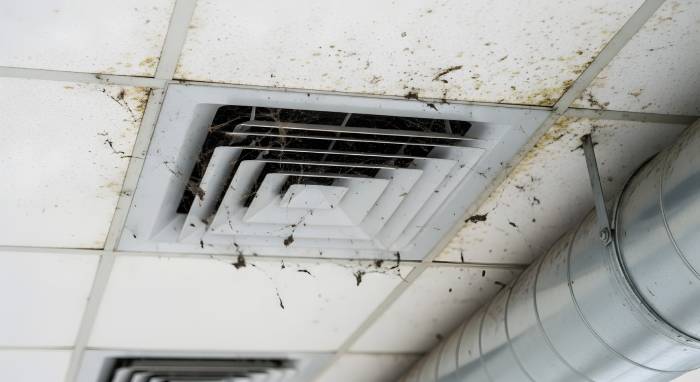
Visible Mold Near Registers or Components
Visible mold near an air duct opening is rarely isolated to that surface. Discoloration near supply vents, return grilles, or insulation points to a moisture problem deeper inside the duct systems.
Occupant Complaints in Specific Zones
Irritation, coughing, headaches, and respiratory symptoms that improve when occupants leave the building are signs of mold contamination in the ductwork serving those areas.
Standing Water in Drip Pans or Mechanical Areas
Standing water in drip pans, condensation on duct insulation, or poorly controlled indoor humidity create conditions where mold establishes quickly. Humidity levels that consistently exceed recommended ranges are an active risk factor for mold contamination inside duct systems.
Declining HVAC Performance
Mold, dust, and debris restrict airflow. Uneven temperatures across the commercial building and rising energy costs without a clear mechanical cause can trace back to mold contamination inside the duct system.
Health Risks of Mold in Commercial Buildings
The health risks of mold exposure are not uniform. Immune status, existing respiratory conditions, and cumulative exposure time all influence how symptoms present. Reported health risks include eye, nose, and throat irritation, persistent coughing, headaches, skin irritation, worsened asthma, and heightened discomfort for occupants with allergies.
When employees or tenants in the same commercial building report similar symptoms within a short timeframe, the building's duct systems need investigating. Ignoring the pattern is how containable mold contamination becomes a building-wide mold remediation project.
Can Mold Grow in Flex Duct?
Yes. Flexible ducts are more susceptible to mold than rigid ductwork. They sag when improperly supported, creating low points where condensation pools, and the interior lining traps moisture in ways that are difficult to clean. Mold contamination inside flexible ducts often goes undetected longer because they are harder to inspect visually. When flexible ducts cannot be adequately cleaned during commercial duct cleaning, replacement is the more practical solution.
Is Duct Cleaning Enough When Mold Is Present?
No. Duct cleaning removes debris from accessible surfaces. It does not eliminate active mold colonies, address the moisture source behind the mold contamination, or prevent recurrence. A complete response to mold in commercial building air ducts includes full inspection of the commercial HVAC system and duct systems, moisture source correction, targeted mold removal, cleaning of accessible components, replacement of contaminated porous materials, and verification that conditions supporting mold contamination have been resolved.
When Mold Remediation Is the Right Call
Professional mold remediation is necessary when mold contamination spans multiple zones, occupants are reporting health risks, moisture problems are ongoing, or visible mold is present around major HVAC components. Commercial mold remediation differs from residential work because the building cannot be vacated. The mold remediation plan and containment strategy must account for operations continuing during the work.
How to Prevent Mold in Commercial Air Ducts
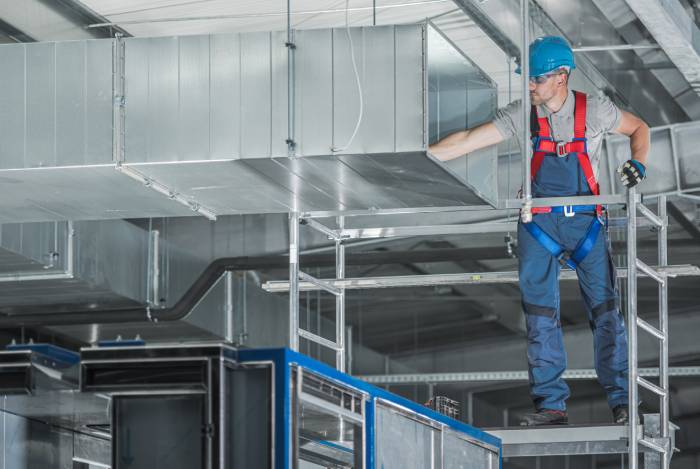
Managing humidity levels across zones is the most effective defense against mold in commercial building air ducts. Routine commercial duct cleaning removes the organic buildup that feeds mold and creates opportunities to catch drainage problems and damaged flexible ducts early. Drip pans need inspection on a fixed schedule. Any water event affecting ductwork should trigger an inspection before the system returns to operation, because running mold spores through wet duct systems spreads mold contamination across the entire commercial HVAC infrastructure.
Schedule Commercial Air Duct Cleaning With ServiceMaster Clean
If your commercial building is showing signs of mold in the ductwork, do not wait for health risks to multiply. ServiceMaster Clean provides professional commercial air duct cleaning services for offices, healthcare facilities, schools, retail locations, and industrial properties. Whether you need routine duct cleaning, mold removal, or help restoring indoor air quality, contact ServiceMaster Clean to schedule an inspection and take the first step toward a healthier building.


